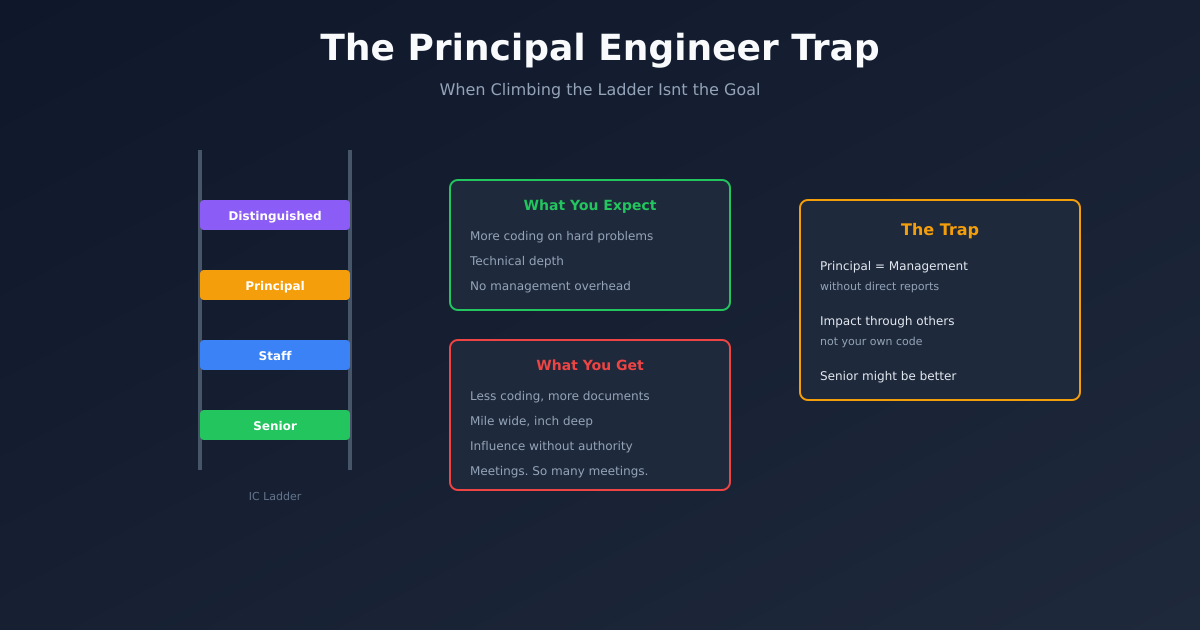
The tech industry built an Individual Contributor ladder so engineers wouldn’t have to become managers. Senior, Staff, Principal, Distinguished - climb the ladder while writing code, not attending meetings.
Except it’s a trap.
The higher you go on the IC ladder, the less you code and the more you do everything you were trying to avoid. I’ve watched great engineers become miserable Principals because nobody explained what the job actually is.
What Principal Really Means
At senior level, you’re accountable for your work. At staff level, you’re accountable for your team’s work. At principal level, you’re accountable for outcomes you can’t directly control.
Principal engineers:
- Define technical strategy across multiple teams
- Influence without authority over people who don’t report to them
- Navigate organisational politics to get things done
- Communicate constantly with stakeholders at all levels
- Write documents more than code
- Attend many, many meetings
If this sounds like management, that’s because it is. It’s management without direct reports, which is often harder than management with them.
The Coding Myth
“I’ll stay on the IC track so I can keep coding.”
This is the lie that draws people up the ladder. It’s true at senior level. Increasingly false at staff. Almost entirely false at principal.
Principal engineers code occasionally. Prototypes, proof of concepts, critical architectural pieces. But most of your impact comes through others. If you’re spending significant time coding, you’re not doing your job.
The math is simple: if you have 10 teams in your scope and each decision you influence saves one engineer-month, your leverage is 10 engineer-months. Your personal coding contribution is one engineer-month at best. The leverage matters more.
This is frustrating for people who became engineers because they love coding. The job that promoted you out of coding is not the job you loved.
Influence Without Authority
Managers can direct people. “Please work on this project.” Principals cannot.
Principal engineers influence through:
- Technical credibility (“they know what they’re talking about”)
- Relationship capital (“they’ve helped me before”)
- Compelling arguments (“this approach is clearly better”)
- Organisational navigation (“they know how to get things approved”)
None of this comes automatically with the title. You earn it over time, and you can lose it quickly.
Influencing without authority is exhausting. You can’t just decide things. You have to convince people, build coalitions, and accept that sometimes you’ll lose despite being right.
The Communication Load
Principals communicate constantly.
With engineers: Explaining technical direction, answering questions, providing guidance, code reviews that are more about education than approval.
With managers: Aligning on priorities, reporting on technical health, flagging risks, advocating for technical investments.
With leadership: Translating technical concepts for non-technical executives, justifying technology decisions, setting expectations.
With stakeholders: Product managers, designers, customers, partners. Everyone wants to understand what’s technically possible.
In writing: RFCs, architecture docs, decision records, strategy documents. Principal engineers write constantly.
If you don’t enjoy communication - if you’d rather put headphones on and code - principal is the wrong job.
The Scope Problem
As you grow in scope, your context shrinks.
A senior engineer might understand one codebase deeply. A principal engineer has to have opinions about dozens of systems they’ve never touched.
You become a mile wide and an inch deep. You rely on others for context, form opinions quickly with incomplete information, and accept that you’ll sometimes be wrong.
This is uncomfortable for engineers who pride themselves on deep technical knowledge. The job requires breadth over depth, which can feel like becoming a worse engineer.
What You Give Up
Taking a principal role means giving up things you might value:
Flow state. Uninterrupted coding time becomes rare. Your calendar fills with meetings. Deep work requires aggressive scheduling defence.
Completion. You rarely finish things yourself. You start conversations, set direction, and let others complete the work. The satisfaction of shipping disappears.
Certainty. At senior level, you know if your code works. At principal level, you’re making bets about the future. You won’t know if you were right for months or years.
Technical depth. Staying current in any technology becomes harder. You know a little about everything, a lot about nothing.
Team camaraderie. You’re no longer part of a single team. You float between teams, belonging fully to none.
Some people are fine with these trade-offs. Others find them devastating.
Signs the Trap Is Closing
Watch for warning signs that principal isn’t right for you:
You resent meetings. Meetings are the job. If every meeting feels like an interruption, you’re in the wrong role.
You feel like a fraud. You’re making decisions about systems you don’t understand deeply. This never goes away - you adapt or struggle.
You miss shipping. The last thing you shipped yourself was months ago. You feel disconnected from the work.
You’re exhausted by people. Every day is conversations, negotiations, relationship management. If people drain you, this depletes your energy.
You’re not influencing. You have the title but not the impact. Your opinions don’t change outcomes. This is a failure state.
Alternatives
Not everyone should be a principal. There are other paths:
Stay senior. Senior is a great job. Deep technical work, clear outcomes, sustainable lifestyle. There’s no shame in not climbing further.
Specialise. Some organisations have specialist tracks - security, performance, machine learning. Deep expertise without broad scope.
Consult. Independent consulting lets you go deep on problems, then move on. No organisational politics.
Small companies. At startups, senior engineers have principal-level impact with hands-on work. The ladder compresses.
Management. If you’re going to do the communication and people work anyway, management gives you direct authority to match.
If You Still Want It
If you’ve read all this and still want principal:
Build influence before title. Start doing principal-level work before you have the title. The title should recognise what you already do.
Invest in communication skills. Writing, presenting, persuading. These become your primary tools.
Accept the trade-offs. You’re choosing leverage over craft. Make the choice consciously.
Find meaning in the work. Principal impact is multiplied through others. Learn to feel ownership over outcomes you didn’t directly create.
Protect what matters. Some principals maintain small coding projects for sanity. Schedule the time. Protect it.
The principal title is prestigious. The job is hard in ways that aren’t obvious from below. Know what you’re choosing.
The best principals I know love the work. The unhappy ones wanted the title without understanding the job.
Make sure you’re in the first group before you sign up.