I have certifications. AWS Solutions Architect, CKA, a few others. They’re on my LinkedIn. Employers have never asked about them.
The dirty secret of tech certifications: they prove you can pass a test, not that you can do the job.
Yet I watch engineers spend months studying for certifications instead of building projects, contributing to open source, or solving real problems. It’s a misallocation of effort that the industry perpetuates.
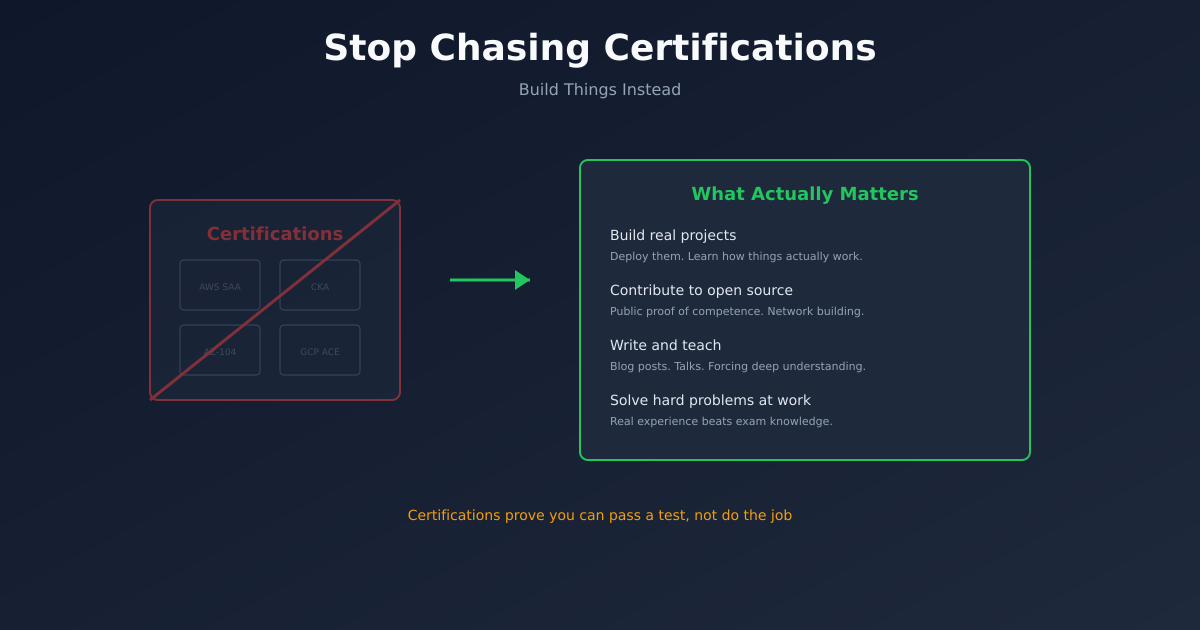
What Certifications Actually Prove
Certifications prove you can memorise information and pass a multiple-choice test. That’s it.
They don’t prove you can:
- Design systems under constraints
- Debug production issues
- Collaborate with teammates
- Make trade-off decisions
- Handle ambiguity
- Ship working software
The gap between certification knowledge and job performance is massive. I’ve interviewed certified engineers who couldn’t explain basic concepts when asked to apply them differently than the exam.
Why They Persist
If certifications don’t prove competence, why does the industry use them?
HR filters. Recruiters need ways to sort thousands of applicants. Certifications are easy checkboxes. “Must have AWS certification” cuts the pile in half.
Vendor marketing. AWS, Google, Microsoft want certified professionals pushing their platforms. They invest heavily in certification programs and encourage employers to require them.
Risk aversion. Hiring managers fear making bad hires. Certifications feel like proof. “They’re CKA certified, so they must know Kubernetes.” It’s false assurance, but it’s assurance.
Career anxiety. Engineers see job postings requiring certifications and panic. They pursue certifications defensively, even when their experience is stronger proof of competence.
The Opportunity Cost
Every hour spent studying for a certification is an hour not spent on something else.
What else could you do with 100 hours?
Build a project. A real project you can demo, explain, and point to. A project teaches you how things actually work, not how the exam says they work.
Contribute to open source. Public contributions demonstrate competence to anyone who looks. They also build network and reputation.
Write blog posts. Explaining concepts forces you to understand them deeply. Published writing is discoverable proof of knowledge.
Solve real problems at work. Taking on challenging projects at your job builds skills and credibility faster than any exam.
These alternatives compound. A project leads to a blog post leads to a conference talk leads to job offers. Certifications just sit on your resume.
When Certifications Make Sense
I’m not saying certifications are always worthless. There are scenarios where they help:
Breaking into the industry. If you have no experience and no portfolio, certifications signal basic competence. They’re a weak signal, but they’re something.
Career changers. Moving from one domain to another, certifications show you’ve invested in learning the new area. Combined with projects, they can help.
Employer requirements. Some employers require certifications for contracts or compliance. If you need the cert to keep your job, get the cert.
Structured learning. Certification curricula provide a learning path. If you learn better with structure, use the cert as a guide - but building is still more valuable than passing.
Specific regulated fields. Security certifications like CISSP carry more weight because the field is more regulated. But even there, experience matters more.
What Employers Actually Want
When I hire engineers, here’s what I look for:
Can they solve problems? Give them a real problem and see how they think. Certifications don’t predict this.
Can they communicate? Can they explain their thinking? Write clear docs? Collaborate effectively? Certifications don’t measure this.
Have they built things? What projects have they worked on? What did they learn? Certifications are not projects.
Do they learn continuously? How do they stay current? What have they learned recently? Certifications are one data point, not proof of ongoing learning.
Do they fit the team? Culture fit matters. Certifications tell me nothing about this.
A strong portfolio with clear explanations beats a list of certifications every time.
A Better Approach
If you want to grow your career, here’s what I recommend:
Build projects. Real things that solve real problems. Deploy them. Write about them.
Learn in public. Blog, tweet, give talks. Document your learning journey. This builds reputation and proves competence.
Solve hard problems at work. Volunteer for challenging projects. Push beyond your comfort zone.
Contribute to open source. Even small contributions demonstrate engagement with the community.
Read broadly. Papers, books, blog posts from practitioners. Deep knowledge comes from diverse sources.
Network authentically. Build relationships in the industry. Opportunities come through people, not certifications.
If you do these things, certifications become irrelevant. Your work speaks louder.
The Credential Trap
Here’s the danger: certifications can become a trap.
You get one certification. It feels good. So you get another. Then another. Before long, you’re spending all your learning time on certifications instead of skills.
This is comfortable because certifications have clear endpoints. Pass the exam, get the badge. Building projects is messier - there’s no certificate for “shipped a production system.”
Don’t mistake the comfort of certification for career progress.
Breaking the Cycle
The industry needs to stop overvaluing certifications.
Hiring managers: Remove certification requirements from job postings unless genuinely necessary. Evaluate portfolios, projects, and problem-solving instead.
Engineers: Stop pursuing certifications out of fear. Focus on building proof of competence that actually matters.
Vendors: Acknowledge that certifications are marketing, not proof of expertise. Stop pressuring employers to require them.
The cycle continues because everyone participates. Change starts with individuals choosing differently.
My Advice
If you’re early career and genuinely have nothing to show, get one or two relevant certifications. They’re better than an empty resume.
If you have any experience at all, invest in building things instead. A GitHub profile with real projects, a blog with thoughtful posts, and a track record of solving problems will serve you better than a wall of certification badges.
The best engineers I know have few certifications. They’re too busy building.