Engineers complain about meetings constantly. Too many meetings. Meetings during focus time. Meetings that could have been emails.
Yet the same engineers schedule meetings when a document would work better. We’ve all done it. It’s the path of least resistance - easier to talk than write.
But the cost of unnecessary meetings is enormous. Let’s fix it.
The Math of Meetings
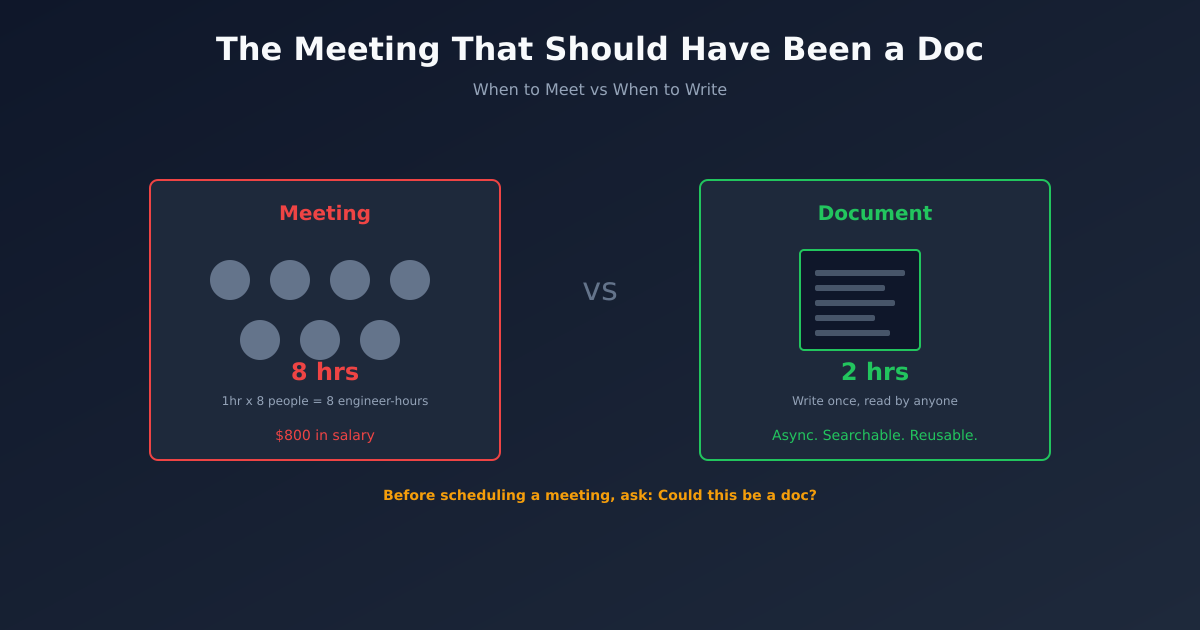
A one-hour meeting with eight people costs eight engineer-hours. If those engineers cost $100/hour loaded, that’s $800 of salary for one meeting.
Now multiply by frequency. Weekly team syncs, daily standups, planning meetings, review meetings, alignment meetings. Companies easily burn 30% of engineering time in meetings.
A document takes maybe two hours to write. It can be read by any number of people asynchronously. If twenty people need the information, a doc costs 2 hours versus 20 meeting-hours.
The math isn’t close.
When to Meet
Meetings aren’t always wrong. They’re the right choice for:
Real-time collaboration. Whiteboarding a design, working through a problem together, pair programming. These need synchronous interaction.
Difficult conversations. Conflict resolution, sensitive feedback, emotionally complex topics. These deserve human presence.
Quick decisions with context. When a decision requires shared context that’s hard to write down, a quick meeting can be faster than a long document.
Building relationships. New teams, new hires, important partnerships. Face time builds trust that async can’t.
Celebrations. Acknowledging accomplishments, team milestones. These deserve shared moments.
Notice what’s not on this list: information sharing, status updates, reviews, presentations.
When to Write
Write instead of meeting when:
Information flows one direction. If one person is sharing and others are receiving, that’s a document. Updates, announcements, reports - all documents.
People need time to think. Complex topics benefit from reflection. A document lets people process, research, and respond thoughtfully.
The audience is large. Coordinating ten people’s calendars for a meeting is hard. A document reaches everyone at their convenience.
The information has lasting value. Meeting content evaporates. Documents remain searchable and referenceable.
Time zones differ. Async is the only humane option for distributed teams.
The topic is detailed. Technical specs, architectural proposals, detailed plans. These need precision that verbal communication lacks.
The Status Meeting Trap
The worst offenders are recurring status meetings. Weekly team syncs, project updates, all-hands.
These meetings follow a pattern:
- One person talks
- Everyone else pretends to listen
- Most information is irrelevant to most people
- Nobody asks questions because they weren’t really listening
Replace with:
- Written update shared before the meeting time
- Optional Q&A session for anyone who has questions
- Cancel the Q&A if there are no questions
You’ll be shocked how often there are no questions.
How to Write an Effective Doc
Meetings persist partly because writing is hard. Make it easier with structure:
TL;DR at the top. The busy reader should get the key points in 30 seconds.
Context. What’s the background? What problem are we solving? Why does this matter?
The actual content. The update, proposal, decision, whatever.
Open questions. What needs input? What decisions remain?
Next steps. What happens after people read this?
Keep it short. Two pages max for most topics. If it’s longer, it’s probably multiple documents.
Making Async Work
Async communication requires discipline:
Give deadlines. “Please review by Friday” instead of letting things languish.
Be explicit about what you need. “I need approval” vs “I need feedback” vs “FYI only.”
Use comments, not new documents. Keep discussion attached to the original document.
Summarise decisions. When discussion concludes, update the document with the outcome.
Don’t expect instant responses. Async means people respond on their schedule. Plan accordingly.
Hybrid Approaches
Sometimes you need both. A common pattern:
- Write first. Document the proposal, problem, or update.
- Distribute for async review. People read and comment on their time.
- Meet to decide. Short sync meeting to resolve remaining questions.
- Document the decision. Update the doc with the outcome.
This approach respects people’s time while ensuring alignment. The meeting is focused because everyone arrives informed.
Changing the Culture
If your organisation defaults to meetings, changing takes effort:
Lead by example. Write docs instead of scheduling meetings. When people see it work, they’ll copy.
Cancel meetings. “I wrote this up instead - let me know if you have questions.” Most of the time, they won’t.
Block no-meeting time. Protect focus time explicitly. Make meetings the exception.
Make documents easy. Good templates, clear expectations, a searchable wiki. Reduce friction for writing.
Question every recurring meeting. “Do we still need this?” should be asked quarterly at minimum.
The Decision Framework
When you’re about to schedule a meeting, ask:
- Could this be a document?
- Does this require real-time interaction?
- Is the content relevant to everyone invited?
- Could this meeting be shorter?
- Does this meeting need to recur?
If you can’t articulate why the meeting is better than a document, write the document.
Respect Time
Every meeting is a request for other people’s time. Time they could spend on focused work, with their families, or taking care of themselves.
Meetings should earn their place on the calendar. Most don’t.
Write more. Meet less. Respect time.