Every few months, another CEO announces a return-to-office mandate. They cite collaboration, culture, and productivity. The articles write themselves: “Remote work was an experiment that failed.”
Except the data says otherwise.
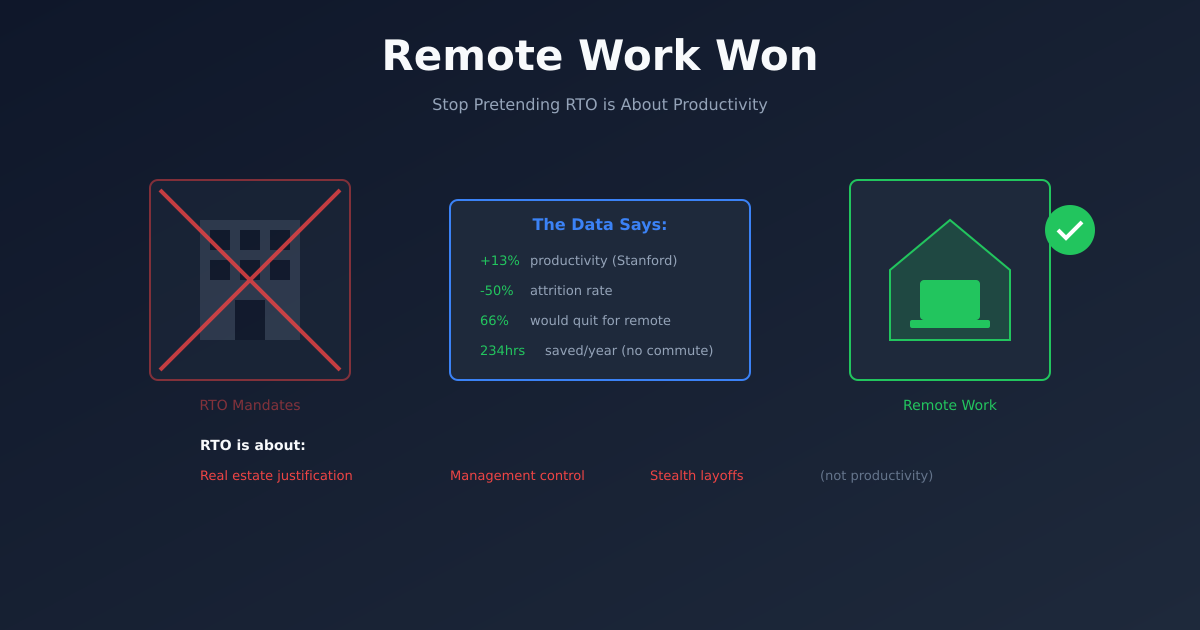
Remote work won. The RTO push isn’t about productivity - it’s about control, real estate, and managers who can’t adapt to managing outcomes instead of presence.
The Data Is Clear
Let’s look at what we actually know about remote work productivity.
Microsoft’s study of 60,000 employees found that remote workers were equally productive as office workers, and often more so for focused work. The caveat was that cross-team collaboration declined - a real issue, but not an argument for full RTO.
Stanford’s research on 16,000 workers showed a 13% productivity increase for remote workers. They also found higher job satisfaction and 50% lower attrition.
Owl Labs found that remote workers put in more hours, take fewer sick days, and report higher engagement. They also found that 66% of workers would look for a new job if forced to return to the office full-time.
GitLab, Automattic, and Zapier have been fully remote for years, scaling to hundreds or thousands of employees. Their output speaks for itself.
The evidence isn’t mixed. It consistently shows that remote work either matches or exceeds office productivity for most knowledge work.
What RTO Is Actually About
If the data favours remote work, why the push to return to offices?
Real estate. Companies signed expensive, long-term leases. Empty offices are embarrassing and expensive. Filling them justifies past decisions, even if those decisions were wrong.
Control. Some managers measure productivity by presence. Seeing butts in seats feels like control. Remote work requires managing by output, which is harder.
Middle management anxiety. Remote work exposes managers who don’t add value. If the team performs the same without the manager walking around, what’s the manager for?
Attrition strategy. Some companies use RTO mandates as stealth layoffs. Announce a policy knowing some percentage will quit, avoiding severance costs.
C-suite lifestyle. Executives often have personal chefs, private offices, and car services. The office is pleasant for them. They don’t experience the commute the same way employees do.
None of these are about productivity. They’re about other things dressed up as productivity.
The Collaboration Myth
The most common argument for RTO is “collaboration.” Remote work harms serendipitous encounters, water cooler conversations, and spontaneous brainstorming.
This argument has some merit - for certain types of work. Early-stage startups, highly creative teams, and situations requiring rapid iteration benefit from being together.
But most engineering work isn’t like this. Most engineering work is focused, individual problem-solving punctuated by planned coordination. This work is better done without the interruptions and noise of an open office.
The collaboration argument also ignores a key fact: modern offices are terrible for collaboration. Open floor plans optimise for density, not communication. People wear headphones to focus. Meetings happen in conference rooms that could just as easily be video calls.
If you want collaboration, design for it intentionally. Periodic in-person offsites, collaborative workspaces for specific projects, and async-first communication practices are more effective than forcing everyone to commute five days a week.
The Commute Tax
The average American commute is 27 minutes each way. That’s 54 minutes per day, 4.5 hours per week, 234 hours per year spent in transit.
That’s six full work weeks per year lost to commuting.
This time isn’t neutral. Commuting is consistently ranked as one of the most stressful parts of people’s days. It’s unpaid labour that benefits the employer while costing the employee time, money, and wellbeing.
Remote work gives that time back. Some people use it for more work (often unreported). Most use it for family, health, or rest. Either way, it improves quality of life without reducing output.
When executives mandate RTO, they’re essentially demanding a pay cut. The cost falls disproportionately on those who live furthest from the office - often because housing near the office is unaffordable.
The Trust Problem
At its core, the RTO debate is about trust.
Managers who don’t trust their employees want to watch them. They want to see people at desks, looking busy. They conflate presence with productivity.
This is a management failure, not a remote work failure.
Good management is about setting clear goals, providing resources, removing obstacles, and evaluating outcomes. None of this requires physical presence.
Remote work doesn’t create lazy employees. It reveals which managers can’t manage without surveillance.
What Actually Matters
If you want productive engineering teams, focus on what actually matters:
Clear goals. People need to know what success looks like. This is hard to define and requires actual management work.
Adequate resources. The tools, access, and support needed to do the job. This includes good equipment for home offices.
Minimal interruptions. Protect focus time. This means fewer meetings, async communication defaults, and respect for deep work.
Autonomy. Let people figure out how to achieve goals. Micromanagement kills motivation and productivity.
Feedback loops. Regular, honest feedback on what’s working and what isn’t. This can happen over video just as easily as in person.
Human connection. Yes, people need social interaction. Periodic in-person gatherings, virtual social events, and team offsites address this better than mandatory commutes.
Notice what’s not on this list: watching people sit at desks.
The Market Speaks
The labour market is the ultimate arbiter of this debate.
Companies that mandate strict RTO lose access to talent that won’t relocate or commute. They compete for a smaller pool of candidates who happen to live nearby and are willing to work in an office.
Companies that offer remote options access global talent. They can hire the best person for the job regardless of geography. They attract workers who value autonomy and flexibility.
Over time, this talent arbitrage compounds. Remote-friendly companies will accumulate better talent, which produces better outcomes, which enables more investment in remote infrastructure.
The companies mandating RTO are making a bet that their employer brand is strong enough to overcome this disadvantage. For most, it’s not.
Hybrid Is a Compromise, Not a Solution
Many companies have landed on hybrid policies: two or three days in the office, the rest remote.
Hybrid is often the worst of both worlds.
You still have the commute, just less often. You still need space for everyone, but it’s empty half the week. Coordination becomes harder because some people are remote and some are in-office on any given day. You can’t optimise for remote (async-first) or in-person (spontaneous) - you’re stuck in the middle.
If you’re going to do hybrid, be intentional about it. Specify which days are in-office for everyone, use that time for collaborative work, and protect remote days for focus. Random hybrid policies satisfy nobody.
The Future
Remote work won not because of COVID, but because the technology finally made it viable. Video conferencing, collaborative documents, async communication tools, and cloud development environments removed the friction that used to make remote work impractical.
COVID accelerated adoption by forcing the experiment. The experiment succeeded. There’s no reason to undo it.
Some companies will mandate RTO anyway. They’ll pay for it in attrition, recruiting difficulty, and the slow bleed of their best people to more flexible competitors.
Others will embrace distributed work. They’ll develop the management practices, tools, and cultures that make it thrive.
The market will reward the latter.
What to Do
If you’re an employee facing RTO mandates, you have options.
Negotiate. Many mandates have exceptions. Make your case based on your productivity and the value you provide.
Look elsewhere. The market is full of remote-friendly companies hungry for talent. Your skills transfer.
Be vocal. Push back on mandates that don’t make sense. Management often reverses course when faced with mass resistance.
If you’re a leader considering RTO, ask yourself honestly: Is this about productivity, or something else? Are you solving a real problem, or just satisfying your own discomfort?
The best companies will figure out how to make remote work work. The rest will learn the hard way that talented people have choices.
Remote work won. The only question is how long it takes everyone to accept it.